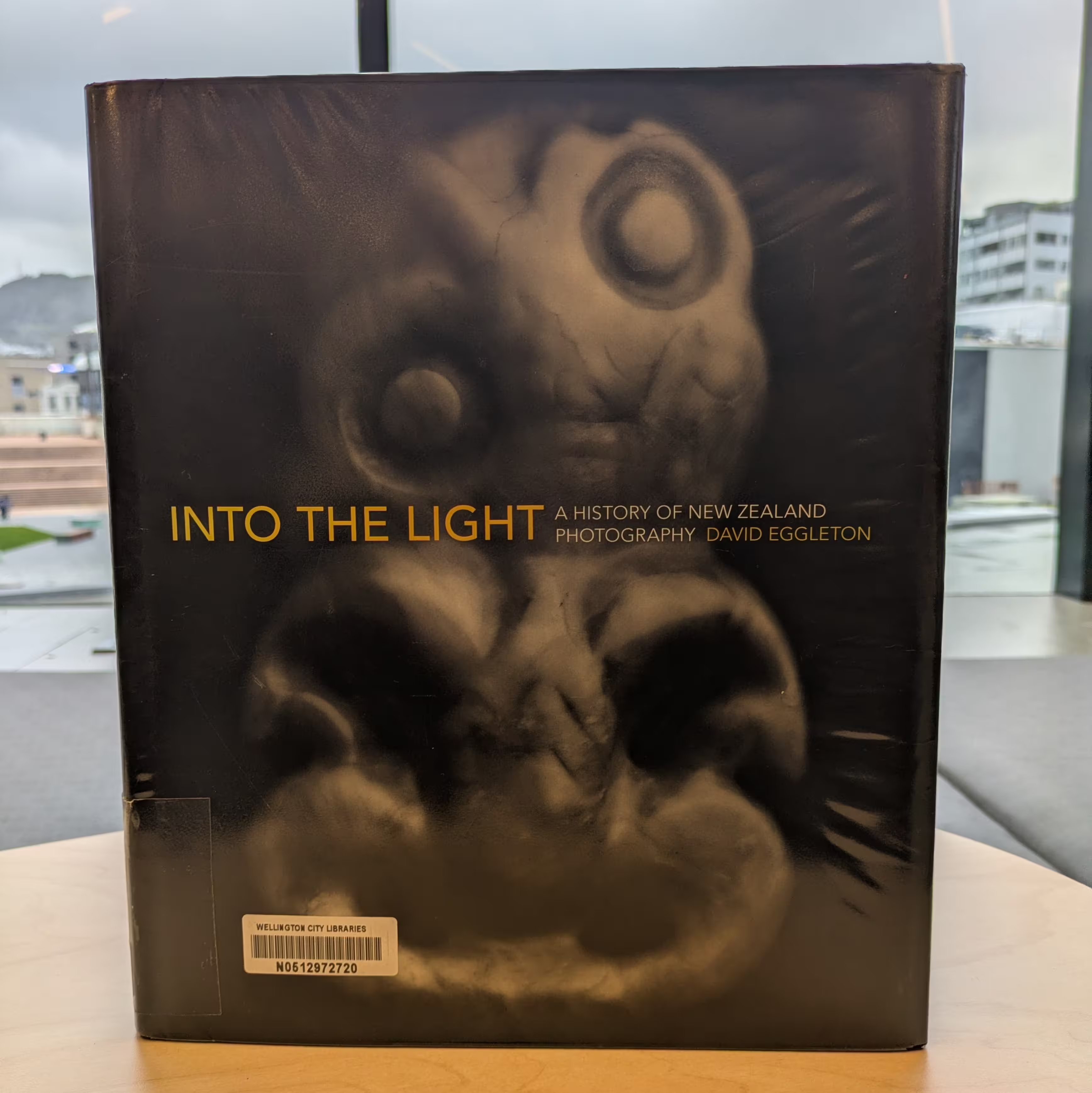
- David Eggleton. Into the Light: A History of New Zealand Photography. 2006.
I was at the newly-renovated Wellington Central Library/Te Matapihi ki te Ao Nui and this book was on display and caught my eye. It is formatted as a coffee-table book and I picked it up to try to understand more about photography in general.
I expect coffee table books to be mostly photography, especially in a book about photography. But even at the “a picture is worth a thousand words” exchange rate, I’m not sure that this book is mostly photography. There are a lot of words. (I actually estimate that it has about 300 words for each picture). Especially the older pictures are kind of small, and not the best to look at late at night, when I do most of my non-work reading. Almost all of the pictures are black and white until the last chapter.
It often happens that one reads commentary on a photograph and then sees the photograph. “Oh, I see what that means.”
As for the content of the text: Eggleton is a decidedly progressive writer (and poet laureate of New Zealand 2019–2022), with this book published in 2006 and expressing viewpoints that are consistent with progressive viewpoints of 2026.
I know nothing about the history of photography in Canada, and I know maybe an above average amount about the history of Canada and New Zealand. We see that the development of photography parallels the development of the settler state; people have been taking pictures about as long as New Zealand and Canada have existed.
The earlier photographs reflect the establishment of the settler state of New Zealand. Many of the early photographers were dedicated amateurs with independent means, with professionalization beginning in the early 1900s. Portraits, of course, were where the initial action was. There were also a fair share of landscapes of Aotearoa and also of its settlement. Although this is not a book about landscape photography, there were a number of early photographers who were also outdoorsmen.
There are women photographers throughout, and more as time goes on. Photography of Māori culture is a recurring motif—there were more Māori than Pakeha in early New Zealand—but the first Māori photographer, John Miller (Nga Puhi) appears on page 133 of 188, covering the famous 1981 Springbook tour (“the last gasp of colonialism”). There are more Māori photographers in the last chapter. Age-wise, though, perhaps fewer than 10 of the featured photographers were under 30 in 2006; many were born in the 1950s, as was the author.
Like any human activity, photography is performed by humans who influence each other in movements, clubs, and schools, and the book discusses e.g. the Colonialists, Pictorialists, Nationalists, and Existentialists, who each value different attributes in their photography. Pictorialism, for instance, aimed to move away from simply recording a scene, and includes a lack of sharp focus and sometimes visible manipulations.
Even though New Zealand is far from everything, there are references to influences from the United States and Europe, particularly in the form of immigrants. Still, probably most of the photographers are New Zealand born. Many of the photographers moved between the New Zealand cities and occasionally the hinterland. (Although: “Oettli registers the craving for personal space that arises when people are crammed together.” In 1970s Auckland? I have a hard time believing that people are crammed anywhere in New Zealand, compared to Asian cities for example.)
The only Canadian content that I noticed was: 1) a quote by John Ralston Saul talking about New Zealand and globalization; 2) a reference to a photographer studying at the University of British Columbia.